If you live in the Tricity, you know the struggle of getting from Zirakpur to Sector 17 or from Mohali to Panchkula during peak hours is a test of patience. The Chandigarh Metro or Tricity Metro has been the “dream project” for over a decade, but as of January 2026, where do we actually stand?
Here is the no-nonsense, latest update on the route, the delays, and when you might actually get to ride it.
The Current Status of Chandigarh Metro Project
| Feature | Details |
| Current Status | Approved but Delayed (DPR awaiting final nod) |
| Project Name | Chandigarh Tricity Metro (Mass Rapid Transit System) |
| Phase 1 Length | 89 km (Expanded from original 66 km) |
| Key Cities | Chandigarh, Mohali (New Chandigarh), Panchkula, Zirakpur |
| Construction Start | Expected 2027 (Delayed from 2024/25) |
| Completion Target | 2032 – 2034 |
| Est. Cost | ₹25,000+ Crore |
Latest News (January 2026 Update)
As of early 2026, the project is stuck in what we call “paperwork limbo.” While the Unified Metropolitan Transport Authority (UMTA) and the governments of Punjab, Haryana, and Chandigarh have agreed on the routes, the final Detailed Project Report (DPR) is still pending final clearance from the Central Government.
- Cost Shock: The estimated cost has jumped massive, now touching nearly ₹25,000 Crore. This has caused some hesitation in funding, with local MPs pushing the Centre to declare it a “Strategic Project” to get faster funds.
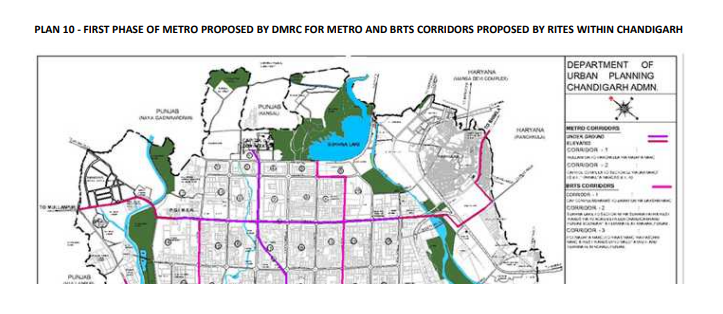
- The Heritage Issue: A big win for purists—the Metro will run completely underground in Chandigarh’s heritage sectors (Sector 1 to 30) to preserve the city’s skyline. Outside these sectors (like in Mohali and Zirakpur), it will mostly be elevated.
Chandigarh Metro Phase 1: The 3 Main Corridors
The finalized plan for Phase 1 covers 89 kilometers across three main lines. This isn’t just for Chandigarh; it connects the expanding suburbs of New Chandigarh and Zirakpur.
Line 1: The East-West Connector (34 km)
Connects New Chandigarh to Panchkula. This is a crucial line for daily commuters traveling between Punjab and Haryana via Chandigarh.
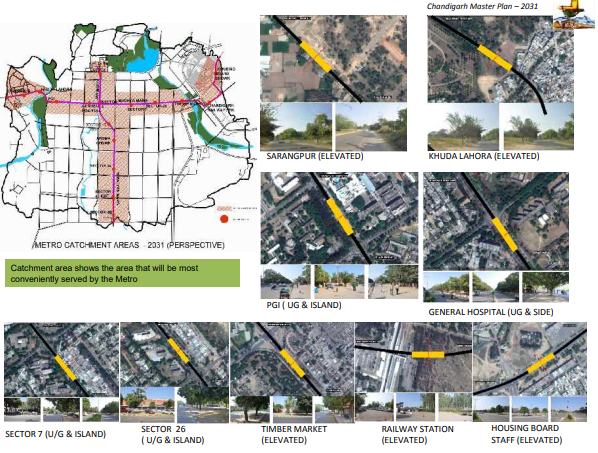
- Route: Paraul (New Chandigarh) ➝ Sarangpur ➝ Khuda Lahora ➝ PGI ➝ Panjab University ➝ Sector 17 (Interchange) ➝ Sector 26 ➝ Chandigarh Railway Station ➝ Housing Board Chowk ➝ Panchkula ISBT ➝ Panchkula Extension.
- Key Stops: PGI, Sector 17, Railway Station, Panchkula ISBT.
Line 2: The North-South Corridor (42 km)
Connects the Tourist Spots to the Airport & Zirakpur. This is likely to be the busiest line, connecting the Rock Garden to the airport and the densely populated Zirakpur.
- Route: Rock Garden/Sukhna Lake ➝ Sector 17 ISBT ➝ Sector 43 ISBT ➝ Fountain Chowk ➝ Himalaya Marg ➝ Mohali Sector 62 ➝ Gurdwara Singh Shaheedan ➝ Chandigarh International Airport ➝ Aerocity ➝ Zirakpur ISBT.
- Key Stops: Sukhna Lake, Sector 43 ISBT, Airport, Zirakpur.
Line 3: The City Connector (13 km)
A shorter line to decongest central traffic.
- Route: Grain Market Chowk (Sector 39) ➝ Vikas Marg ➝ Tribune Chowk ➝ Transport Chowk (Sector 26).
Understanding the Chandigarh Metro Map – Underground vs. Elevated
One of the most confusing parts for residents is figuring out where the train goes underground.
- Underground Zone: If you are in Sector 1 to Sector 30 (Chandigarh), you won’t see pillars or bridges. The stations and tracks will be below ground to keep Le Corbusier’s architecture visible.
- Elevated Zone: Once the line hits Mohali, Zirakpur, or Panchkula, it pops up onto elevated tracks (pillars). This saves cost and is faster to build.
When Will Chandigarh Metro Construction Actually Start?
If you read older news, they said construction would start in 2024. That obviously didn’t happen.
The Realistic Timeline:
- 2026 (Current Year): Final approval of the DPR by the Union Cabinet and funding allocation. Land acquisition talks begin.
- 2027: Tenders released for construction. Groundbreaking ceremony (Bhoomi Pujan) likely late 2027.
- 2032: First section (Priority Corridor) opens to the public.
- 2034: Full Phase 1 operational.
Most locals are skeptical about the dates but agree that without the Metro, the Tricity traffic is becoming unmanageable. The “Zirakpur Jam” alone is reason enough for many to support this project, regardless of the cost.
Is the Chandigarh Metro project confirmed?
Yes, it is confirmed and approved by the Tricity state governments (Punjab, Haryana, UT). However, it is currently waiting for the final financial nod from the Central Government of India.
Which areas will Chandigarh Metro cover in Phase 1?
Phase 1 covers New Chandigarh (Mullanpur), Central Chandigarh (Sectors 17, 43, PGI), Panchkula (ISBT to Extension), Mohali, Zirakpur, and the International Airport.
Will the Chandigarh Metro be underground or elevated?
It is a mix. It will be underground in Chandigarh’s heritage sectors (1-30) and elevated in Mohali, Panchkula, Zirakpur, and non-heritage sectors of Chandigarh.
Does the Metro go to Chandigarh Airport?
Yes, Line 2 connects Rock Garden directly to the Chandigarh International Airport (via Mohali) and further to Zirakpur.
When will Chandigarh Metro start running?
Realistically, do not expect a ride before 2032. Construction is expected to begin in 2027, taking about 5 years for the first phase.
What is the route of the Chandigarh Metro in Zirakpur?
The line will enter Zirakpur from the Airport/Aerocity side, touching the Zirakpur ISBT. It is designed to relieve the heavy traffic jam at the Zirakpur border.
Who is building the Chandigarh Metro?
The project is being handled by the Chandigarh Metro Rail Corporation (CMRC), with RITES (a government engineering firm) handling the planning and DPR.
What is the ticket price (fare) for Chandigarh Metro?
Fares have not been finalized yet, but like Delhi Metro, they will likely range from ₹20 to ₹60 depending on the distance traveled.
Will the Metro connect to the Railway Station?
Yes, Line 1 has a dedicated station at the Chandigarh Railway Station, making it easy to switch from Indian Railways to the Metro.
Why is the Chandigarh Metro Project delayed?
The main delay is due to “Heritage” concerns (which forced the expensive underground plan) and disagreements over cost-sharing between Punjab, Haryana, and the Centre.